.svg?format=webp)


A comprehensive protection plan tailored for civil servants
Is government healthcare enough? Are you covered after retirement?+
Why Should Civil Servants Buy Insurance?

.svg?format=webp)
Unlike private‑sector employees, civil servants mainly rely on government‑provided healthcare services, such as free general outpatient clinics, dental services, and specialist outpatient care. Without the protection of employer‑provided group medical insurance, having dedicated medical coverage becomes especially important.
.svg?format=webp)
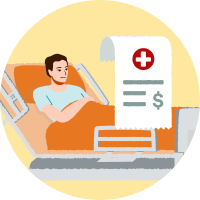
When choosing private hospitals or private healthcare services, consultation, treatment, and hospitalisation costs are generally borne by the individual, creating a significant financial burden without dedicated medical protection.
.svg?format=webp)
.svg?format=webp)
With the right medical and protection solutions, you can flexibly adapt coverage to different life stages, building more comprehensive protection for yourself and your loved ones.
What types of insurance are suitable for civil servants?
If you were hospitalized because of an illness, would you prefer to receive prompt treatment or wait your turn in line?

Even if you have medical coverage, do you have enough financial resources to cover your living expenses if you face a serious illness or after you retire?

If an accident occurs, are you prepared to handle the financial impact right away?


Medical Insurance
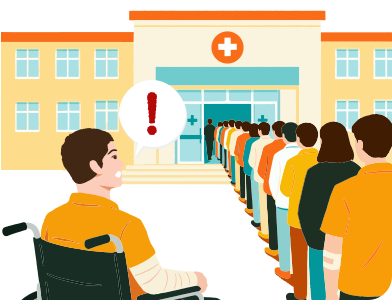
Medical benefits for civil servants primarily cover services provided by public hospitals and do not include private hospitals.
With public healthcare resources under pressure, waiting times depend on the severity of the condition, location, and patient volume. Even civil servants are required to follow the established waiting mechanism.
When illness strikes and timely treatment is a priority, many people choose to seek care at private hospitals, where the related medical expenses are generally paid out of pocket.
Comprehensive medical insurance gives you greater freedom of choice, helping you access timely treatment and seize critical moments for care.


- Standard Semi‑Private Room2
- Annual benefit limit of up to HK$16.5 million
- Suitable for customers seeking comprehensive protection for themselves and/or their children
- Tax deductible3

- Standard Ward Room
- Annual benefit limit of up to HK$4 million
- Suitable for customers who wish to enjoy private medical coverage in addition to public hospital services


Term Critical Illness Insurance


1 in 4 people will be diagnosed with cancer⁴
Recurrence rates of 3 major critical illnesses
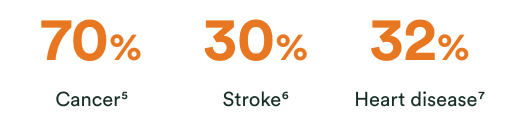
Critical illnesses carry a real risk of recurrence. Even after successful recovery, long-term follow-ups, ongoing treatment or rehabilitation support may still be required. Related medical expenses may not end with a single claim.
If you are a new-terms civil servant appointed on or after 1 June 2000, you will no longer be entitled to government-provided medical benefits after retirement. In such cases, prolonged and ongoing medical expenses may need to be covered using savings originally set aside for retirement.
Critical illness insurance provides a lump-sum payout with no restriction on usage, allowing you to settle medical expenses immediately or reserve the benefit for living expenses and retirement planning.


- Lump‑sum payout8 up to HK$2.5 million9 (100% of the Sum Insured)
- Coverage for up to 62 critical illnesses10
- Only 2 simple underwriting questions, no medical check‑up required


Personal Accident Insurance
.svg)
Civil service roles are often regarded as secure positions with comprehensive benefits, but accidents are unpredictable and do not discriminate by occupation.
In the event of an accident, beyond medical and rehabilitation expenses, work arrangements and daily life may also be significantly affected.
Personal accident insurance provides immediate financial support when the unexpected occurs, helping to ease sudden financial pressure and reduce the impact on you and your family.

- Broad accidental death and disability coverage
- First-in-market11 Scar due to Accident cover12
- 24-hour Worldwide Assistance Service
Want to know more
What is VMIS?
VMIS (Voluntary Medical Insurance Scheme) is a voluntary medical insurance scheme introduced by the Hong Kong Government for civil servants and non‑civil servants employed by the Government, as well as their eligible family members. The scheme is designed to supplement existing public healthcare benefits by offering eligible individuals a wider range of medical choices and additional protection when needed.
What’s the difference between VMIS and VHIS?
The key differences lie in their target customers and nature of coverage:
VMIS (Voluntary Medical Insurance Scheme for Civil Servants and Non‑Civil Servants Employed by the Government)
- Designed specifically for civil servants, non‑civil servants employed by the Government, and their eligible family members
- Offers a wider range of insurance products, including but not limited to certain VHIS‑certified plans, critical illness plans, and personal accident insurance
- Primarily serves to supplement existing medical benefits for civil servants
VHIS (Voluntary Health Insurance Scheme)
- Applicable to all Hong Kong residents
- Covers only government‑certified individual indemnity hospital medical insurance plans
- Eligible premiums are tax‑deductible, subject to statutory limits
Tip: Not all VMIS plans are VHIS‑certified. Only VMIS products that are also VHIS‑certified qualify for tax deductions on eligible premiums.
Why Do Civil Servants Still Need VMIS?
Although civil servants are entitled to public hospital services, they may still face the following limitations in practice:
- Long waiting times (for example, specialist outpatient appointments may take a year or more)
- Out-of-pocket expenses for certain medications, diagnostic tests, or medical equipment
- Medical benefits may not continue after retirement
VMIS offers more flexible and higher-quality medical options, such as:
- Access to private hospitals or clinics, significantly reducing waiting times
- Faster access to treatment, allowing you to seize critical treatment windows
- Coverage for your own and your family’s medical needs
- Additional tax benefits when choosing VHIS-certified VMIS products, subject to eligibility